Facts on this page come from the CFA, FIFe and GCCF registries, published genetics, nutrition and behaviour studies, and Singapore's NEA and AVS, checked in November 2026. Each one links to its source, and claims from individual catteries are labelled.
Three blacks, two genes
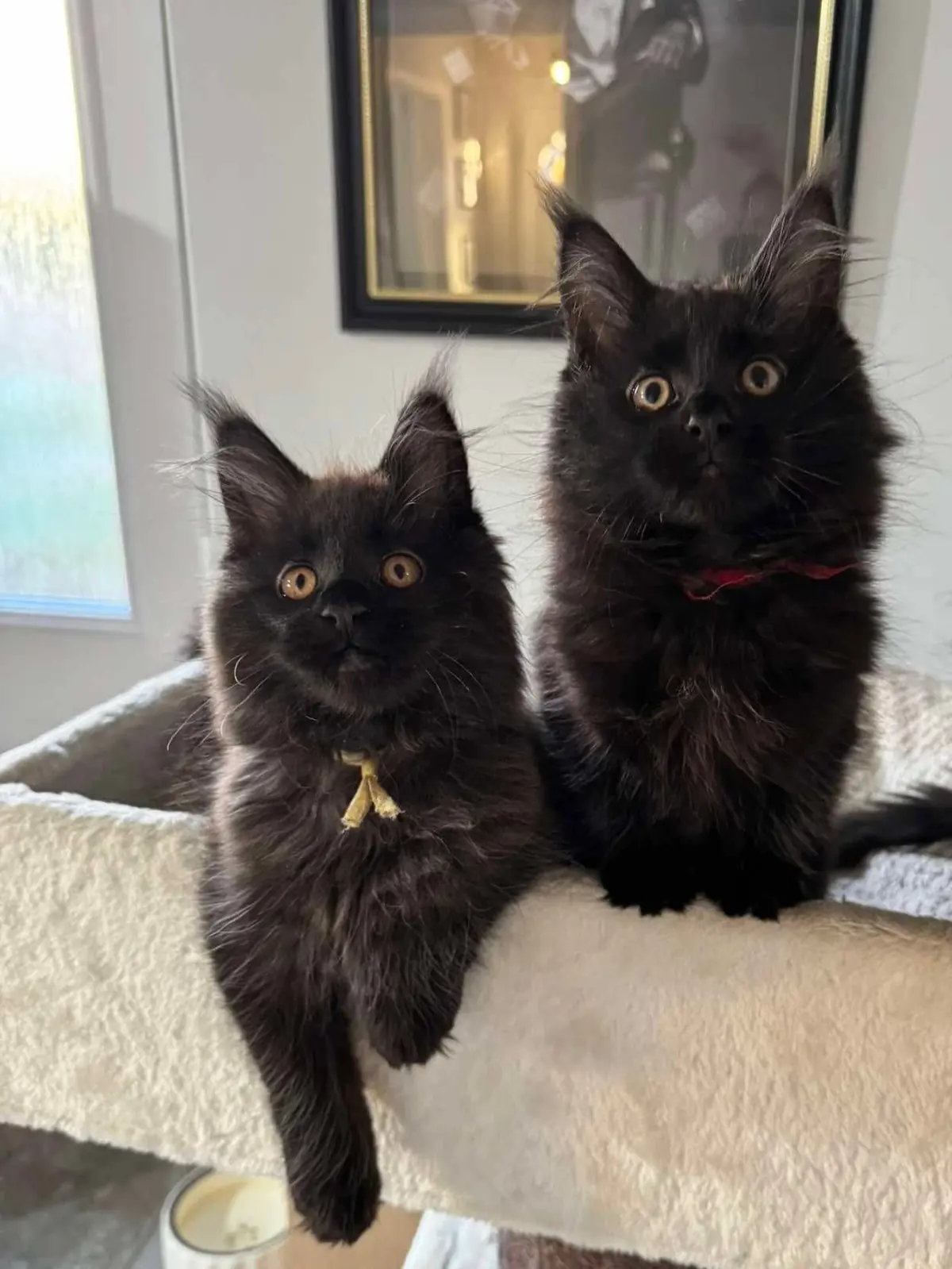
A black Maine Coon cat can have one of three different coats: solid black, black smoke or black tabby. Our Maine Coon colours guide covers every colour. This guide goes deeper into the blacks.
Two genes do the sorting. The agouti gene decides whether a tabby pattern shows. The silver gene, also called the inhibitor, decides whether the base of each hair is white (CFA genetics guide, Menotti-Raymond et al. 2009). Two switches give four cats:
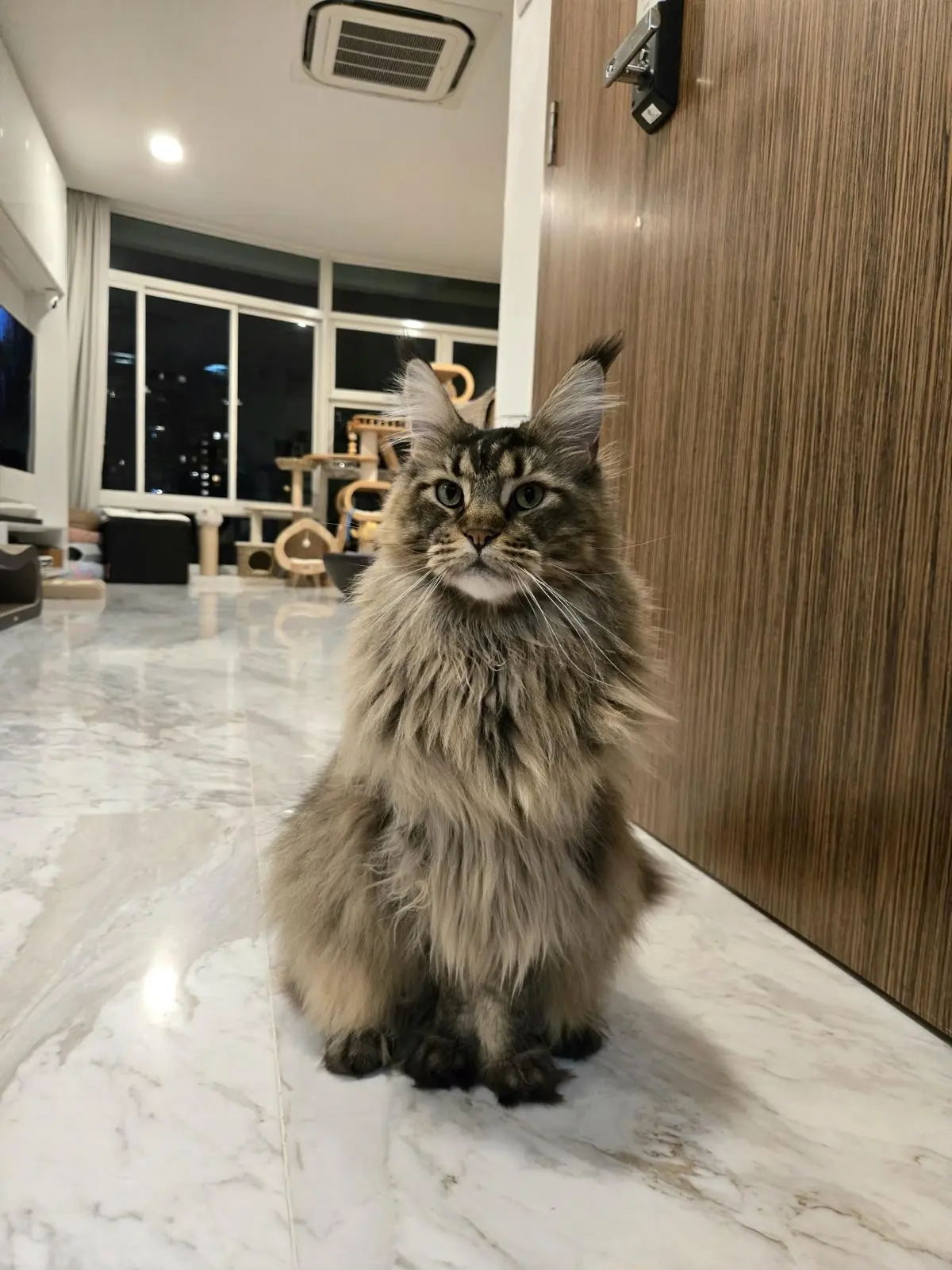
In CFA's standard, a solid black is a dense coal black from root to tip, with no rusty tips and no smoky undercoat. A black smoke has a white undercoat under deep black tips, with a light silver ruff and ear tufts. A brown tabby has dense black markings on a bright, coppery-brown ground (CFA standard), and European pedigrees call it black tabby (PawPeds).
Oddly, the silver gene acts most strongly on red and yellow pigment, which is why a tabby's warm bands turn white (Menotti-Raymond et al. 2009).
How to tell them apart: part the coat
In an adult, part the fur down to the skin on the neck, ruff and flanks, and look at the roots:
- Black to the skin: solid black.
- White roots under black tips: black smoke, usually with a silvery ruff and ear tufts.
- Banded hairs and a pattern on a warm brown ground: black (brown) tabby.
- A black pattern on a pale silver ground: black silver tabby.
Check the face and nose too. FIFe gives a smoke silvery fur round the eyes and silvery frown marks at the base of the eyebrows (FIFe). In CFA's standard, solid blacks and smokes have black noses, while silver tabbies and shaded silvers have brick-red ones (CFA standard). Real cats vary, so the nose is only a clue. Our own tip: blow gently into the coat to open it.
Shaded and shell silvers can pass for a pale smoke, especially in photos. They carry silver too, but FIFe classes them as tabby patterns and counts tabby marks as a fault (FIFe). Parted, a shaded hair is mostly white with a dark tip, and a smoke hair mostly dark with a white root.
| Colour (EMS code) | The hair | Nose (CFA) |
|---|---|---|
| Solid black (n) | Black to the root | Black |
| Black smoke (ns) | Black with a white base | Black |
| Black shaded silver (ns 11) | White with a dark tip of about 1/4 to 1/3 | Brick red, outlined in black |
| Black shell or chinchilla (ns 12) | White with a tiny tip of about 1/8 | Brick red, outlined in black |
| Black silver tabby (ns 22–25) | Banded, on a pale silver ground | Brick red preferred |
| Black (brown) tabby (n 22–25) | Banded, on a warm coppery ground | Black or brown preferred |
Sources: CFA standard, FIFe.
The codes in brackets are EMS codes, used on WCF pedigrees: n is black, s adds silver, 11 and 12 mean shaded and shell, and 22 to 25 are the four tabby patterns (FIFe). TICA and CFA pedigrees write the colour in words.
Smoke or solid? Why kittens are hard to read
A newborn smoke can look just like a solid black, apart from pale fur round the eyes and a paler belly. Its undercoat starts to show at about 3 weeks, and the coat can look mottled by 6 to 8 weeks (CFA Hints). A 1995 article on smoke Persians, hosted by CFA, gives 6 to 12 weeks for the undercoat, and describes a reverse coat at about 4 months, with pale tips and dark roots (CFA 1995). FIFe agrees that smoke kittens often show markings or reversed contrast that fade (FIFe).
Full contrast can take until the adult coat comes in at about 2 years (CFA Hints). One US Maine Coon cattery says some of its smokes keep changing until 3 or 4 years, and tells buyers not to judge from newborn or 4-week photos (Dashing Coons).
So a kitten's coat at 12 weeks, the youngest a Singapore pet shop may sell a kitten (AVS), is only a preview. Size keeps changing for years too, as our size and growth guide explains.
It works the other way too. A young solid black can look smoky: its kitten coat is often lighter than the adult colour, with rusty or coppery tones, a few white or silver hairs and a lighter ruff. CFA calls this normal until the adult coat arrives at 12 to 18 months (CFA Hints).
At rest and in motion
The registries define a smoke by how it looks moving. Sitting still, a black smoke looks solid black. When it walks, stretches or turns, the white undercoat shows (CFA standard, FIFe). FIFe wants strong contrast, and prefers smokes without ghost tabby marks.
Catteries that keep smokes say the contrast shows best on the neck, shoulders, belly, flanks, ruff, chest and base of the tail. One adds that daylight brings out the silver, while a dim room can make a smoke look almost black (CoonSpire, Dashing Coons). Some catteries also sort smokes into deep, medium and light. No registry uses those terms.
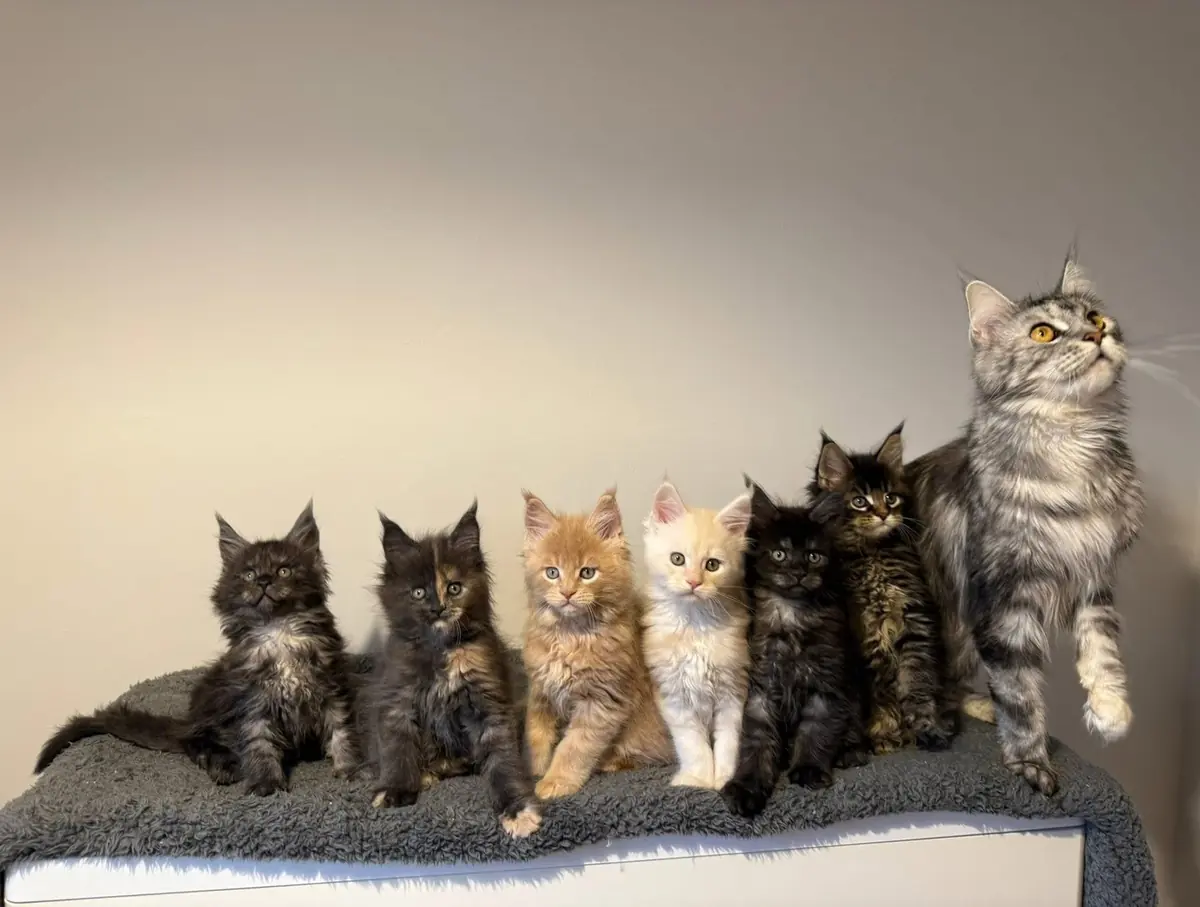
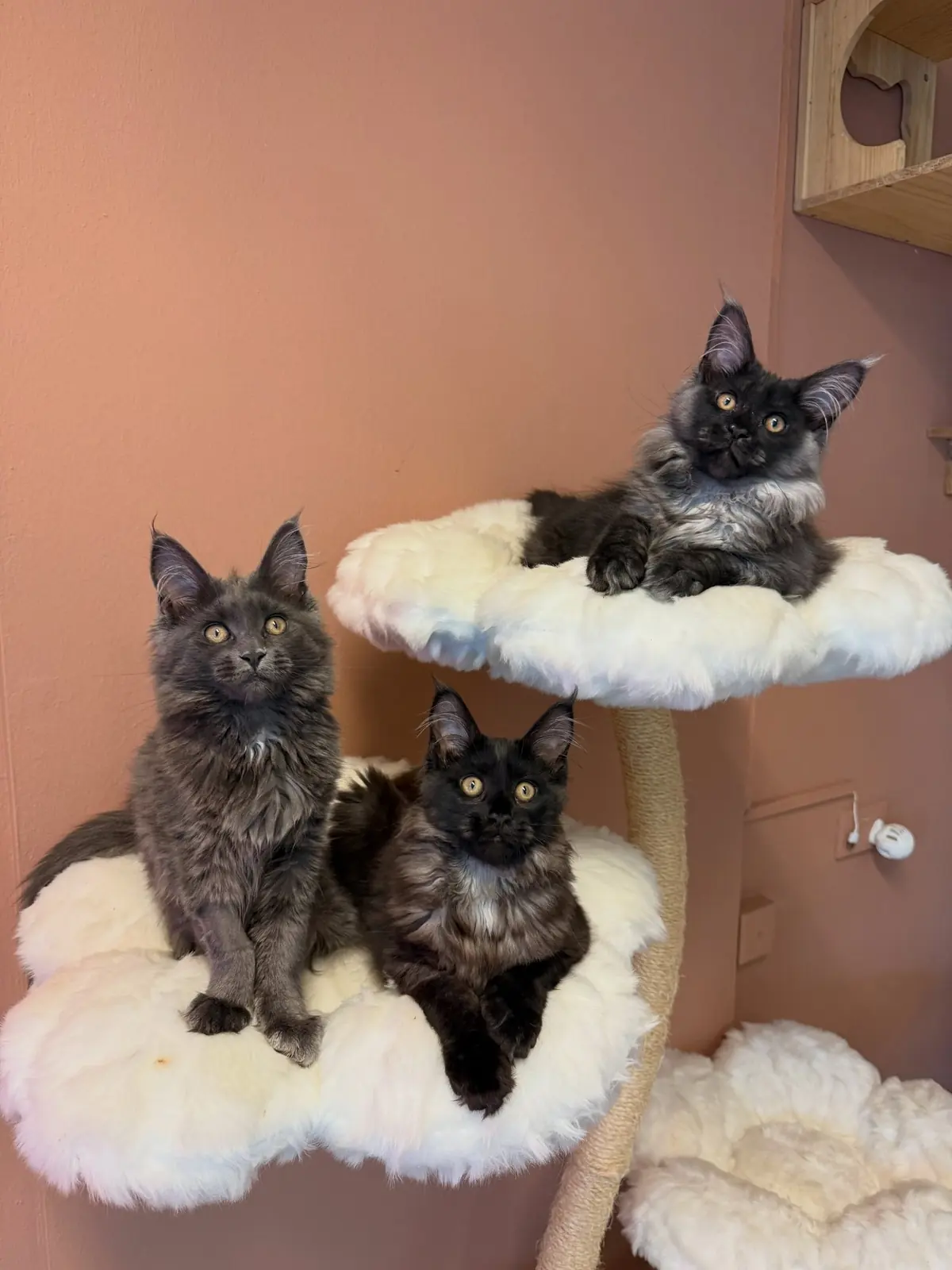
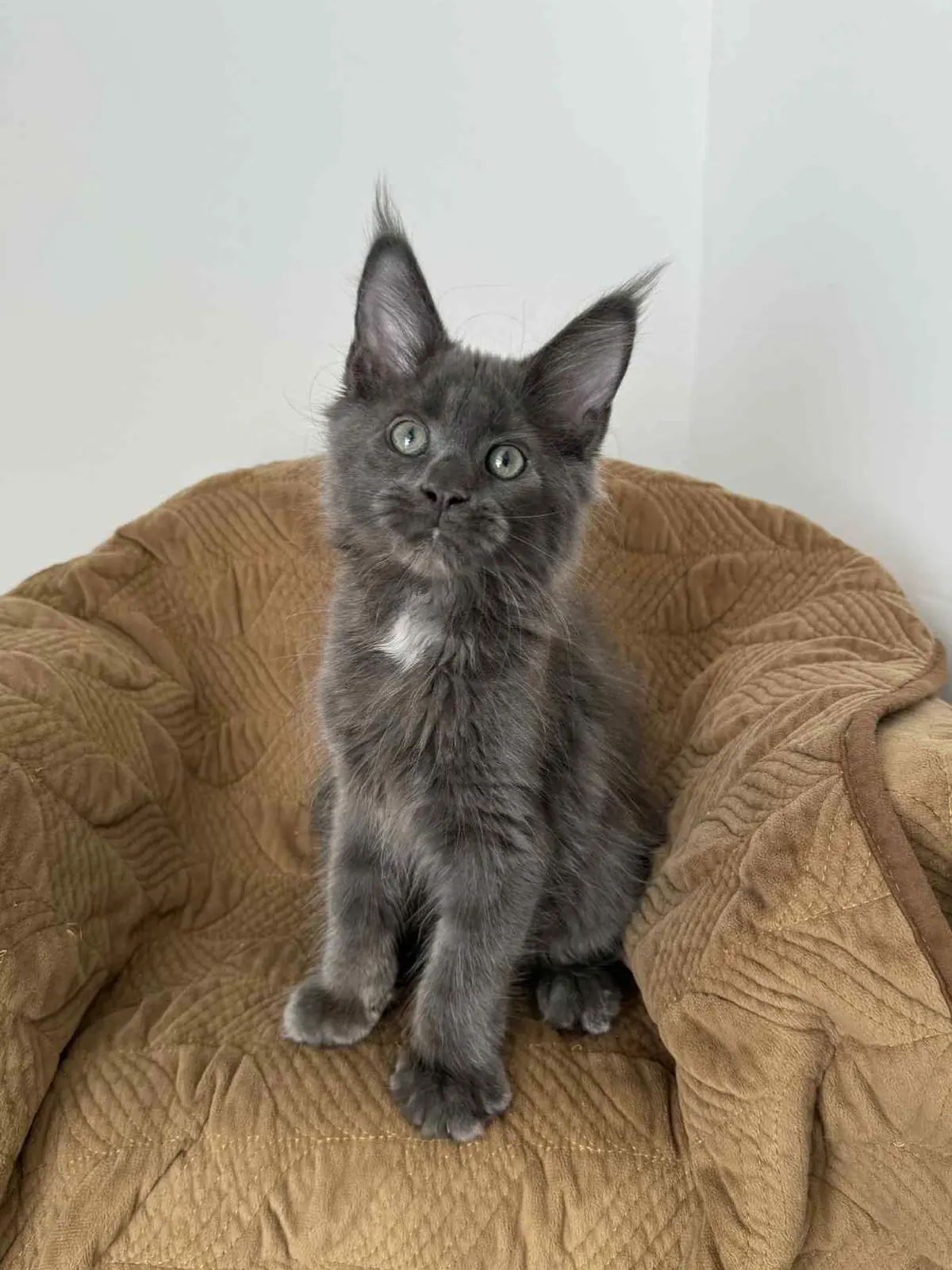
Blue is diluted black (GCCF), so these blue smoke kittens show the same coat in a softer colour.
When a DNA test helps
If the exact colour matters to you, a DNA test can help. The University of Missouri offers a silver test using four cheek swabs. It shows whether a cat carries one or two copies of the silver variant, though the lab says the gene behind it is still undetermined (University of Missouri). GCCF links to it as a way to decode tricky colours (GCCF).
A Chinese lab, Petgeno, began offering a second silver test to European breeders in 2023. Read either result with some care. A 2026 review found that neither lab had published peer-reviewed validation, and Missouri has found cats that look silver but carry neither known variant (Górska et al. 2026).
Silver alone can't separate a smoke from a silver tabby, because both carry it. The difference between them is the agouti gene, and commercial cat DNA panels already test it: a 2022 study used results from 11,036 cats, 1,971 of them Maine Coons (PLOS Genetics 2022).
What to look for when you choose a black or smoke kitten:
A smoke kitten from two solid black parents.
At least one parent carries silver: a smoke, shaded or silver tabby.
The colour judged from one newborn or 4-week photo.
Recent daylight photos of the parted coat.
Nobody can tell you the parents' colours.
Photos of both parents, and their colours on their pedigrees.
Why a black coat goes rusty
A reddish-brown cast on a black coat is called rusting, and CFA's standard wants a solid black with no rusty tinge at the tips (CFA standard). The research points to three causes:
- Kitten coat. Rust is normal in a black kitten until the adult coat arrives at 12 to 18 months (CFA Hints).
- Diet. This is the best-studied cause. In controlled UC Davis trials, black cats on purified diets low in tyrosine turned reddish-brown, then black again when tyrosine or phenylalanine was added (Yu et al. 2001). Below 16 g of phenylalanine plus tyrosine per kg of diet, the hair turned reddish. The authors advised at least 18 g/kg, more than double the 1986 kitten recommendation of 8.5 g/kg, which was set for growth alone (Anderson et al. 2002).
- Sun. The case for sun rests on breeder tradition. The same 1995 article on smoke Persians says sun can rust a smoke's top coat (CFA 1995). We found no study that has measured it in cats.
We couldn't confirm whether everyday cat foods reach that 18 g/kg, so feed a complete, balanced diet and ask your vet before adding a tyrosine supplement. Our FAQ explains how to switch a new kitten's food gradually. Rust in a kitten is usually just the coat maturing. Rust in a well-fed adult that stays out of the sun is a reason to see a vet, especially with other changes such as weight loss or a greasy, unkempt coat.
Grooming a black or smoke coat
A black coat needs the same care as any Maine Coon coat. GCCF advises regular grooming to prevent knots and mats (GCCF), and our grooming guide sets out a daily routine.
Smokes need extra care with knots, because their white is in the undercoat. The 1995 smoke Persian article warns that pulling out a knot takes the undercoat with it, and the fur can grow back dark (CFA 1995). Comb tangles out gently before they become mats.
Black-cat myths
Studies on black cats mostly measure people, and that is where they find the bias. None we found has measured a difference in how black cats behave. A black Maine Coon is as playful and people-oriented as any other.
- Unfriendly? In a survey of more than 1,200 cat owners, solid black was among the colours less often reported as aggressive, while torties and calicos were reported as more aggressive. The cats themselves were not observed (Stelow et al. 2016).
- Unlucky? A 2024 study found an implicit bias against black cats in dog people but not in cat people, and a second, smaller study found it about 40% larger near Halloween. The samples were small: 114 adults, then 37 students (Elvers et al. 2024).
- Harder to rehome? The evidence is mixed. A Colorado State University study found adult black cats waited 4 to 6 days longer for adoption than most other colours (Colorado State University), though a later review puts the gap at about 2 days. Other studies found yellow or white cats waiting longer than black ones (Elvers et al. 2024).
- Less healthy? We found no study comparing health by colour in black or smoke Maine Coons. The known colour-linked problems in cats involve white or pale coats, the PAX3 blue-eye gene and the rare male tortie, as our colour guide explains.
Our black kittens
Our kittens come from partner catteries in Europe, and their pedigrees are issued by WCF, TICA or CFA, depending on the cattery. Litters come in a mix of colours, so the colours available change from litter to litter. To see who is available now, visit our available Maine Coon kittens page or follow us on Instagram @mainecoon.sg, where we post new kittens first. You can also book a private viewing to meet them at our cattery in Joo Chiat. If you want a black or a smoke, WhatsApp us and we will send you photos of the parents.
Questions about black Maine Coons
Why is my black Maine Coon kitten going rusty?
Usually because it is still a kitten. CFA calls rusty or coppery tones normal in black kittens until the adult coat comes in at 12 to 18 months. In adults, diet is the best-studied cause: in UC Davis trials, black cats on diets low in tyrosine and phenylalanine turned reddish-brown. A 1995 article on smoke Persians also blames strong sun, though we found no study that has measured it. If a well-fed adult that stays out of the sun goes rusty, see a vet.
How can I tell a black smoke from a solid black?
Part the fur on the neck, ruff or flanks. A solid black is black right down to the skin. A black smoke has white roots under black tips, and a silvery ruff and ear tufts. In a kitten, check the parents too: a smoke needs at least one silver parent, and its full contrast can take about two years to show.
Is there a DNA test for black smoke?
Yes. The University of Missouri offers a silver test using cheek swabs, and a Chinese lab, Petgeno, began offering one in 2023. A 2026 review found that neither had published peer-reviewed validation. Combined with an agouti test, a silver result should separate solid black, smoke, black tabby and silver tabby. That pairing is our own inference from how the genes work.
Are black cats unlucky?
Luck is a human idea, and that is where the studies find the bias. A small 2024 study measured an implicit bias against black cats that was about 40% larger near Halloween. In a survey of more than 1,200 cat owners, solid black was among the colours less often reported as aggressive.
Is a black tabby the same as a brown tabby?
Yes. European pedigrees, which use EMS codes, call it black tabby, and CFA calls it brown tabby. Both mean black tabby markings on a warm, coppery-brown ground.
See who is available now, or visit our cattery in Joo Chiat by appointment.