Facts on this page come from breed standards, published studies, and veterinary, cat-welfare and Singapore sources, checked in November 2026. Each one links to its source.
Three ways to look white
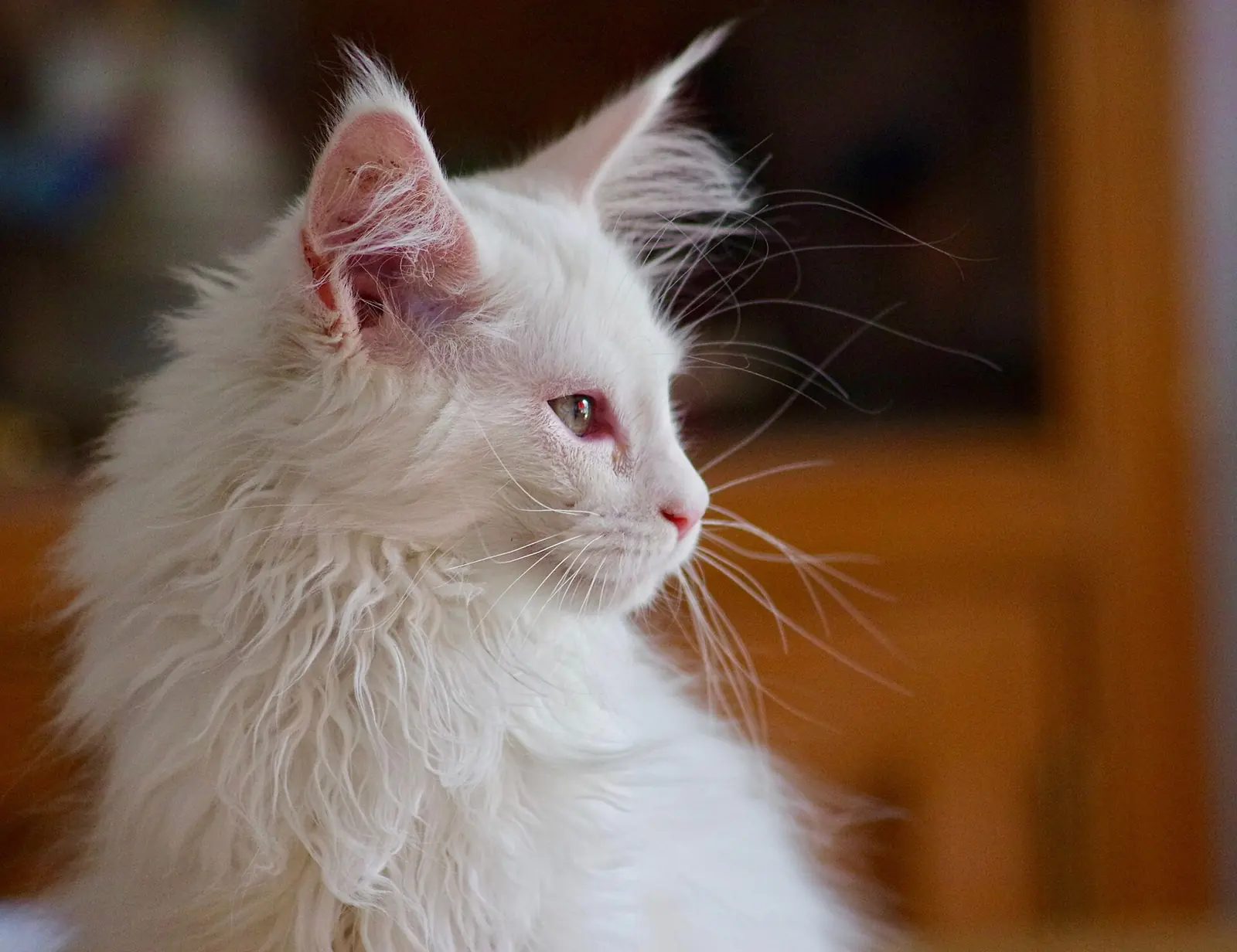
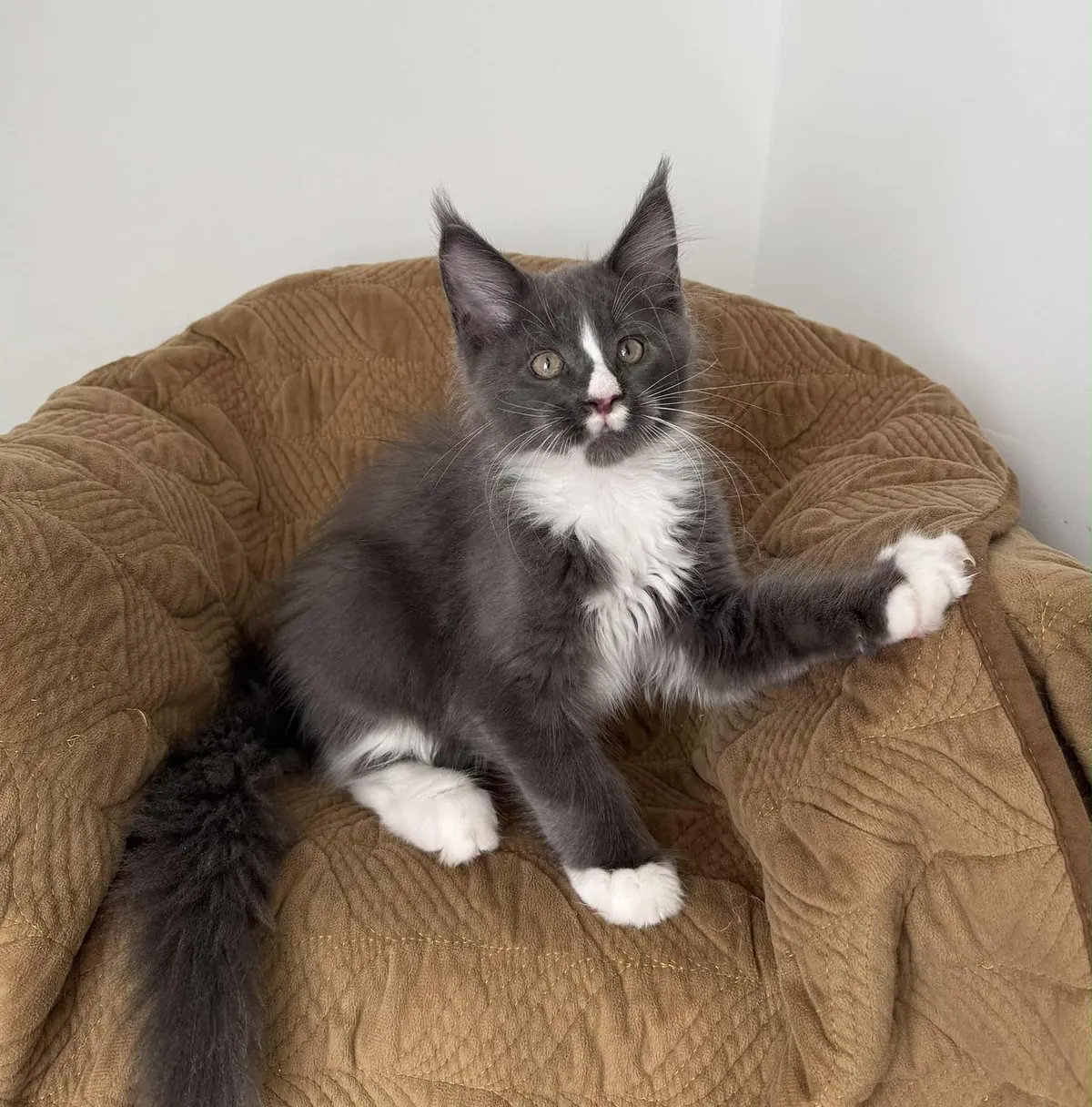
A Maine Coon cat that looks white can be one of three things, and only the first is a true white. Our Maine Coon colours guide shows how every colour is built.
- Dominant white. The whole coat is white. A gene called W stops pigment cells reaching the skin and hair, and often the eyes and inner ears too (David et al. 2014). This is the white linked to deafness.
- White spotting. White patches on a coloured cat, from a bicolour (a third to half white) to a van, mostly white with colour on the head and tail (PawPeds). It comes from another version of the same gene and has not been linked to deafness (David et al. 2014, LSU). In a UK study, none of 61 coloured littermates of white kittens was deaf (Mari et al. 2019).
- A very pale coat. A shell, chinchilla or pale cream silver can look white from across a room, but its hairs still carry colour. In a shell, only about an eighth of each hair, at the tip, is coloured. A shell or shaded cameo kitten can even be born looking white, with red tips that come through over weeks to months (CFA Hints).
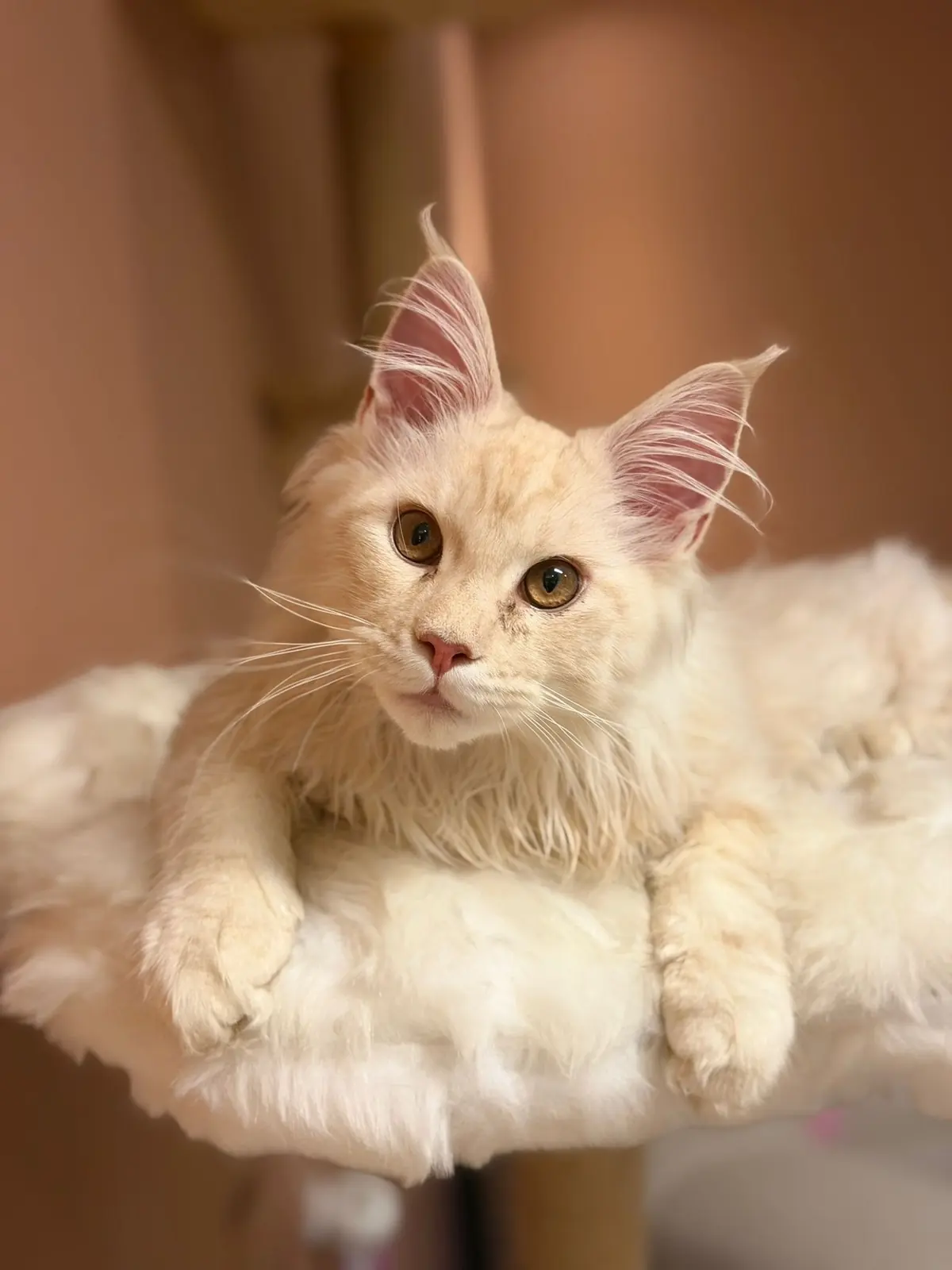
A true white has no markings or shading of any kind, and a pink nose and paw pads (FIFe). On a European pedigree, a white's EMS code is w (FIFe), while a pale silver's keeps its colour letter and adds s for silver (PawPeds).
What the white coat hides
Dominant white covers a coloured cat like a sheet. Underneath, the cat keeps its own colour and pattern genes and passes them on to its kittens (CFA). One copy of W is enough for a white coat (David et al. 2014).
White kittens are often born with a small smudge of colour on top of the head, a kitten cap that hints at the colour underneath (FIFe, CFA). It usually fades by about nine months (CFA Hints), though FIFe says only once the cat is fully grown.
Eye colours: blue, gold, green, copper or odd
A white Maine Coon can have green, gold, green-gold or copper eyes like any Maine Coon. It can also have blue eyes, or odd eyes: one blue and one of the other colours (CFA, FIFe). European pedigrees write the eye colour into a white cat's EMS code (FIFe, GCCF):
MCOMaine Coon
wwhite
61blue eyes
62copper or orange eyes
63odd eyes
64green eyes
Blue or odd eyes come only with the white genes, or with a rare blue-eye gene, PAX3 DBE (dominant blue eye). That gene is linked to deafness too: all eight DBE cats tested in one study had reduced or no hearing (Rudd Garces et al. 2024). FIFe's rules from 1 July 2026 require a PAX3 test for every blue- or odd-eyed Maine Coon unless both parents are proven free (FIFe rules).
Registries differ on which cats may have them:
| Registry | Blue or odd eyes allowed in |
|---|---|
| FIFe | White, van and harlequin |
| WCF | Blue in pure white; odd eyes also in van, harlequin and bicolour |
| GCCF | Pure white only |
| CFA | White and any cat with white |
| TICA | White and with-white |
Sources: FIFe, WCF, GCCF, CFA, TICA.
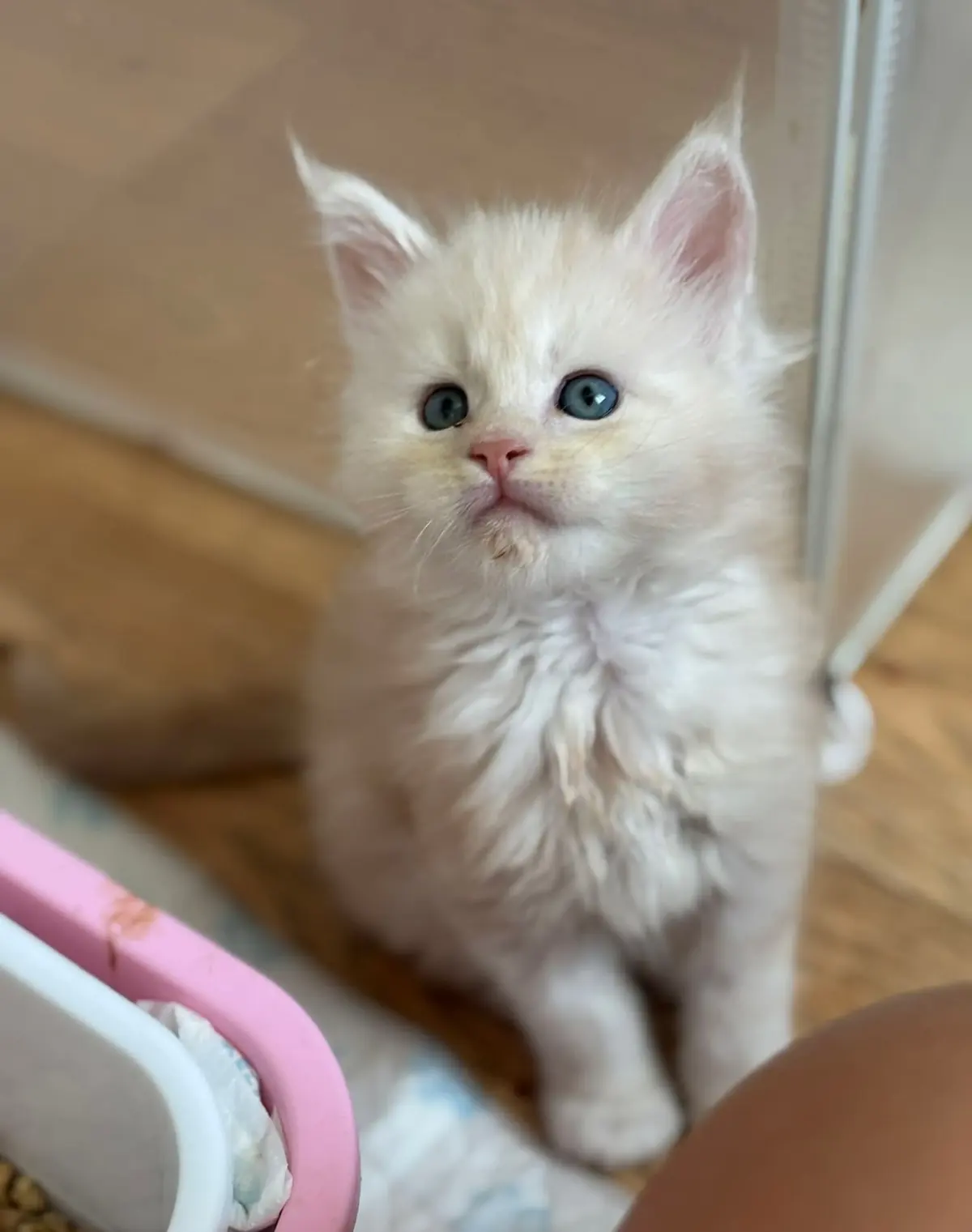
Every kitten starts with blue eyes, so a young white kitten's eyes may still change colour over its first few months (CFA Hints).
Deafness: the real numbers
Deafness in white cats comes from missing pigment cells in the inner ear. The inner ear looks normal at birth, and in affected kittens it breaks down within the first one to three weeks (David et al. 2014, MSD). There is no cure (Cornell).
You will often read that 65–85% of white cats with two blue eyes are deaf, about 40% with one blue eye and 17–22% with none (Cornell). Those figures come from 1970s breeding colonies that mated deaf white cats together on purpose, including cats with two copies of W (Geigy et al. 2007).
Modern studies that hearing-tested owned pedigree white cats found lower rates, counting deafness in one or both ears. They found 20% of 84 cats deaf in Germany, 30% of 132 kittens in the UK and 17% of 72 cats in Poland (Cvejic 2009, Mari et al. 2019, Kortas et al. 2022). Germany and the UK found more deafness with two blue eyes. Poland found no clear link, and its authors urged hearing tests for white cats whatever their eye colour.
So eye colour is no safe shortcut: white cats with gold, copper or green eyes can be deaf too. All three studies also counted their white Maine Coons separately:
Sources: Cvejic 2009, Mari et al. 2019, Kortas et al. 2022.
We found no larger study. Small as the samples are, they show why every white kitten needs a hearing test.
One ear or two
About half of deaf white cats are deaf in one ear only, and in the Polish study two in three were (Cvejic 2009, Mari et al. 2019, Kortas et al. 2022). A cat deaf in one ear can seem to hear normally, and behaviour tests often miss it (Strain 2017). A BAER hearing test finds it (MSD).
Odd-eyed white cats tend to be deaf on the blue-eyed side (Cornell). In the Polish study, both deaf cats with one blue eye were deaf on that side (Kortas et al. 2022).
The BAER hearing test
BAER stands for brainstem auditory evoked response. FIFe prefers it for its accuracy and because it finds deafness in one ear (FIFe). It works like this (Kortas et al. 2022, Cvejic 2009):
- Sedation and sensors. The kitten is usually sedated, and small electrodes go just under the skin.
- Clicks, one ear at a time. An earphone plays clicks into one ear while a masking noise plays in the other. Then the other ear is tested.
- The brain answers. The electrodes record the brain's response to the clicks. Normal hearing means a response from both ears.
The result is reliable from about 6 to 8 weeks old, when a kitten's hearing responses have matured (Cvejic 2009). Because the damage happens in the first weeks of life, a test from that age shows whether a kitten has this inherited deafness. There is no DNA test for the deafness itself (LSU).
Since 1 June 2016, GCCF has required a certificate showing hearing in both ears before a white cat can go on its breeding register (GCCF). FIFe does not allow deaf cats to be bred from, and prefers BAER for testing white cats before breeding (FIFe). We found no hearing rule for white Maine Coons from CFA or TICA (World Cat Congress).
If you already have a white cat and want its hearing checked in Singapore, ask your vet about a referral. BAER testing is done at specialist or referral centres (MSD, International Cat Care).
Sun safety in Singapore
White cats, and cats with white ears, are the most prone to sun damage, which often starts as redness and scaling on the ear tips (MSD). Too much sun can lead to a skin cancer, squamous cell carcinoma, on the ear tips, nose, eyelids and lips of white and lightly pigmented cats (Cornell). Pale cats such as creams can be at risk too, and our orange Maine Coon guide covers creams.
Vets advise keeping cats at risk indoors from 10 am to 4 pm (MSD). Singapore's strongest sun falls inside that window: on clear days, the UV index commonly reaches very high or extreme between 11 am and 3 pm (NEA). A typical day peaks at about 6 to 9, and extreme days reach 11 or 12 (Mothership). Even a typical peak can reach 8, the level at which the WHO tells people to avoid the midday sun (WHO).
- Shade at midday. Keep a white cat indoors or in a shaded catio at midday, and watch its favourite sunny window and balcony spots.
- Careful with sunscreen. Cats lick it off, and the zinc oxide and salicylates in human sunscreens are toxic to them. Use only a product your vet approves (ASPCA).
Keeping white white
The breed standards ask for a pure, glistening white, with no yellow tinge in an adult (CFA, FIFe). A long white coat shows every mark, so it needs regular brushing. Our grooming guide covers the routine.
Reddish-brown staining under the eyes is a sign of tears overflowing. The cause can be a blocked tear duct or an eye problem such as an infection or an ulcer, so the stain deserves a vet check before any cosmetic cleaning. Keep the area clean and dry, use no product without your vet's advice, and never use hydrogen peroxide products near the eyes (VCA).
Living with a deaf cat
A deaf cat can be a good companion with a few changes at home (Cornell, International Cat Care). Signs that a cat may be deaf include not responding when called, being easily startled and not minding the vacuum cleaner (Cats Protection). A cat deaf in one ear may show none of these. Our guide on when to take your Maine Coon to the vet lists other signs to watch for.
- Keep it indoors. A deaf cat cannot hear cars or dogs. Keep it indoors with plenty of toys, or give it only a safe, enclosed outdoor space (Cornell, Cats Protection).
- Let it see or feel you coming. Approach from the front with heavy footsteps, and wake it by touching its bed or the area next to it (International Cat Care).
- Use signals. Teach a few hand signals and use them the same way every time, or flash a torch (Cats Protection).
- Microchip it. A microchip helps if the cat ever gets out (Cats Protection), and in Singapore every pet cat must have a microchip and a licence anyway (AVS).
- Mesh on the windows. AVS requires owners to take reasonable steps to stop cats roaming or falling from height, such as mesh, grilles or screens (AVS). A deaf cat cannot hear a hazard, so in a high-rise flat this rule matters twice over. See our HDB guide for the other rules.
Our white kittens and health guarantee
Our kittens come from partner catteries in the UK, France, Germany and Denmark, and our litters come in a mix of colours. To see who is available now, visit our available Maine Coon kittens page or follow us on Instagram @mainecoon.sg.
Every white kitten from our cattery is hearing-tested before it flies to Singapore. Our health guarantee, and what it covers, is explained in our FAQ. You can also book a private viewing at our cattery in Joo Chiat, or WhatsApp us with any question about a white kitten.
Questions about white Maine Coons
Are white Maine Coons deaf?
Some are. In three modern hearing-test studies, 17 of 59 white Maine Coons were deaf in one or both ears, about 29%. That is our simple sum of small samples, not a meta-analysis, and the studies ranged from 15% to 44%. About half of deaf white cats are deaf in one ear only. The often-quoted 65 to 85% for blue-eyed white cats comes from 1970s breeding colonies that mated deaf white cats together.
Do blue eyes mean a white cat is deaf?
Not always. In German and UK studies of white pedigree cats, about 44% and 50% of those with two blue eyes were deaf, more than in cats with other eye colours. A Polish study found no clear link, and white cats with gold, copper or green eyes can be deaf too. Only a hearing test can tell.
How is a cat's hearing tested?
With a BAER test. Clicks are played into one ear at a time while small electrodes under the skin record the brain's response, usually under sedation. It finds deafness in one ear as well as in both, and gives a reliable result from about 6 to 8 weeks old. In Singapore, ask your vet about a referral.
Are your white kittens hearing-tested?
Yes. Every white kitten from our cattery is hearing-tested before it flies to Singapore. Our health guarantee is explained on our FAQ page.
How do I protect a white cat from the sun?
Keep it indoors or in the shade in the middle of the day. A veterinary manual advises 10 am to 4 pm for cats at risk, and in Singapore the UV index is often very high or extreme between 11 am and 3 pm on clear days. Use only a sunscreen your vet approves, and show your vet any scab on the ear tips, nose, eyelids or lips that keeps coming back.
See who is available now, or visit our cattery in Joo Chiat by appointment.